How to Play Pocket Aces (AA) in PLO6 – Six Card Omaha Strategy Guide
Pocket aces are widely regarded as the strongest starting hand in No-Limit Hold’em, and are often straightforward to play. However, PLO6 is a fundamentally different game, and the value of AA changes significantly as a result. This article builds on our PLO6 introduction and hand strength guide by focusing on how one specific premium holding – pocket Aces – behaves in the unique ecosystem of Six Card Omaha. For a broader overview of the game, see our Introduction to PLO6 Strategy.
In PLO6, hand strength is driven less by rank and more by structure. As a result, aces do not function as a stand alone premium in the same way they would in NLHE, and their playability depends heavily on factors such as connectivity, suits, and the general strength of the four other cards. Our PLO6 Hand Strength Guide explains why straights and nut flushes gain so much relative power.
This article examines how AA should be played in PLO6, and how variations in hand structure influence both pre and post flop decision making.
Why AA Works Differently in PLO6
As already alluded to above, AA on it’s own is not quite the same powerhouse as it is in NLHE or even regular four-card PLO. While it remains a strong starting point, its overall value is largely depends on the quality of the accompanying cards.
To show you what I mean, I have used the Grindersvault PLO6 calculator. In the screenshot below, you can see an example of a ‘bad’ AA hand vs a strong, connected and suited hand.

As you can see, the AA hand has limited connectivity and the Aces have no suits. Also, the suits we do have are covered by the opponents higher-suited cards. The non-AA hand has huge potential to make straights and flushes, as well as having cards unblocked by the AA hand. As a result, in this specific example, AA has approximately 40% pre flop.
For context, a comparable situation in four-card PLO yields a very different result. Even a weak AA hand such as AA72 rainbow remains a slight favourite against a premium double-suited holding like QJT9, typically retaining around 51% equity. This highlights the extent to which additional hole cards in PLO6 increase the relative value of connected and suited hands, while reducing the stand alone strength of aces. Of course, in NLHE, AA will always be a huge equity favourite.
While weak AA hands can be clear underdogs, it is equally important to recognise that even well-structured aces will not automatically lead to a large equity advantage.
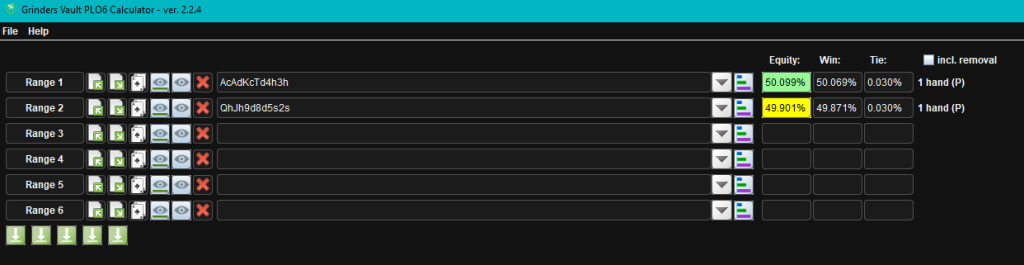
As you can see above, we have a strong AA holding with good connectivity and suit potential. In this example, it is matched up against a very coordinated and suited hand. You will notice that the equity difference is extremely minimal, and that this is effectively a coin flip.
This result becomes even more interesting when comparing the relative hand strengths.

The AA holding in this example ranks within approximately the top 1% of all possible PLO6 hands.

While the opposing hand falls significantly lower in overall ranking, it only comes out as a top 22% hand. Despite this, their HU equity remains effectively even.
This reinforces a key concept in PLO6: even at its best, AA does not dominate opposing ranges in the way players might expect. Instead, outcomes are heavily influenced by board interaction and post-flop play.
Strong vs Weak AA Hands in Six Card Omaha
The strength of AA in PLO6 is primarily determined by three factors: connectivity, suit quality, and side cards. Despite the similarity in equities of the hands above, the hand AcAdKcTd4h3h is an example of a strong AA holding. The Aces are suited; meaning you have nut flush potential twice, AKT and A34 are very connected cards for straight potential, and outside of the nut flush potential, you also have heart flush possibilities with the 4h3h. All these together make this a top-1% hand in PLO6. This hand will generally be a good candidate to play aggressively pre-flop, as a result.
Connectivity determines whether AA can make strong hands beyond top set/boat. In PLO6, straight potential is particularly valuable due to the increased number of available combinations. Hands that include connected cards, such as AKQJ or T987, can interact with a wider range of board textures and generate additional equity through straight draws and redraws.
In contrast, disconnected AA holdings rely heavily on flopping a set and are less able to continue on coordinated or dangerous boards. The hand from earlier, AhAs7d6c2c2d is a good example of this. Its straight and flush potential outside AA is extremely limited, resulting in much lower overall equity.
As touched on above, suit quality is a very important factor when analysing the strength of your holding. With regards to AA specifically, both Aces being suited will create two opportunities to make the nut flush. If the Aces are not suited, your nut potential becomes more limited, and you’ll be looking more towards straights or sets.
Remember, in PLO6, the ability to make the nut flush is far more important than simply making a flush.
The power of AA in PLO6 is hugely dependent on the side cards surrounding it. The connectivity and suits will determine how aggressively you should look to play the hand in question.
Preflop Strategy with AA in 6 Card Omaha
Pre-flop strategy with AA in PLO6 is highly dependent on hand structure. Rather than treating all aces as automatic value hands, the level of aggression should be adjusted based on how well the hand is can realise equity post-flop.
Well-structured AA holdings, particularly those with strong connectivity and double/triple-suits, are well-suited to more aggressive pre-flop play. These hands can interact with a wider range of board textures and generate equity through straights, flushes, and redraws, making them more comfortable playing larger pots.
In contrast, poorly structured AA hands should often be played more cautiously. Holdings that lack connectivity or meaningful suit potential are much more reliant on flopping a set, and will often struggle to continue on low-runout boards. In these cases, avoiding unnecessary pre-flop escalation can help prevent difficult post-flop situations.
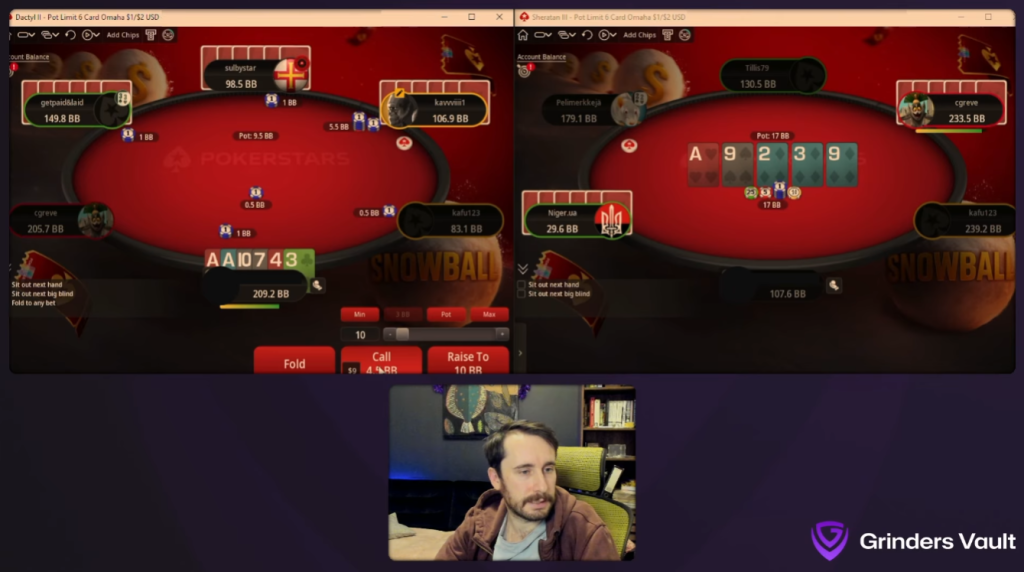
Here, James chooses to flat call this 5.5x raise pre-flop due to the slight lack of co-ordination his hand has.
As pots go multiway, the value of AA decreases further. Well-coordinated hands will have more potential to do well, while overpairs lose relative strength. As a result, position plays an important role in determining how aggressively AA should be played, with greater caution required in earlier positions due to the potential for pots to have several different hands involved.
Postflop Decision Making with AA in PLO6
The way you navigate post-flop with AA in PLO6 will largely depend on how your hand has interacted with the board. While you could simply flop top set or something similarly strong, AA will often be insufficient on its own, with monotone or simply co-ordinated boards causing AA’s strength to shrivel.
On favourable boards, such as ace-high or less coordinated paired textures, AA can continue to apply pressure, particularly when supported by strong redraws. However, caution is still warranted, as opponents can frequently connect with paired boards in PLO6. This will largely depend on how the hand has been approached pre-flop (and possibly on opponent specific factors).
By contrast, a co-ordinated board will often lower the value of the AA holding. Without any straight or flush potential provided by the side cards, you will often be unable to continue with aggression and may find yourself simply giving the hand up on the flop. This is particularly likely if the pot has gone multiway.
As a result, post-flop play with AA should focus less on the strength of the pair itself, and more on how the hand interacts with the board. Without additional equity through draws or redraws, AA will, on its own, often function as a marginal holding rather than a dominant one.
Final Thoughts on PLO6 AA Strategy
AA is certainly a strong starting point in PLO6, but you cannot simply assume you have the best hand as a result of having it. Unlike in other poker formats, it is not a guaranteed large pre-flop equity advantage, and you have to consider the hand’s relative strength based on the side cards – and their potential to connect to the board.
As a result, in PLO6, AA is a hand that can provide a foundation, but the cards surrounding it will determine its true value.
Summary
In PLO6, pocket Aces are only dominant when combined with strong connectivity, suit quality, and side-card synergy. Weak AA holdings often lose to coordinated rundowns. The best PLO6 AA strategy focuses on structure, position, and post‑flop playability rather than raw rank.
Further PLO6 Reading:
Not automatically. Hand structure often outweighs pure rank in Six Card Omaha.
Weak AA hands often perform poorly in multiway pots; avoid inflating pots without connectivity or suit quality.
Additional hole cards increase the likelihood that opponents hold coordinated rundowns, making raw overpairs weaker.